
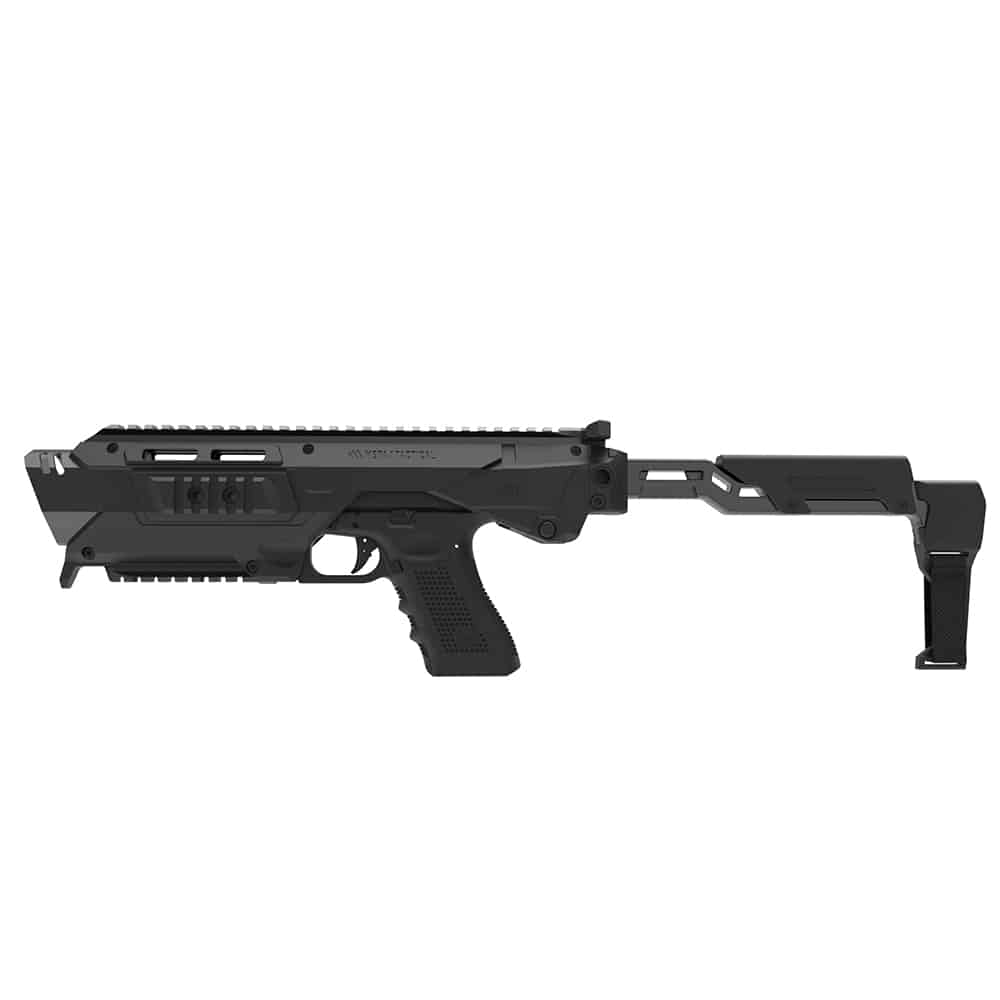
Glock chassis kits have a reputation problem. Most of them look great on Instagram, then turn up at the range with a flimsy plastic charging handle, a rail that won’t hold zero, and a fit that works for exactly one pistol. The Meta Tactical MX-1 was designed to fix all three problems. One chassis takes more than 70 Glock models, plus Polymer80, PSA Dagger and Ruger RXM frames, and you install the pistol without tools.

The MX-1 debuted at SHOT Show 2025. It has since built up a long list of range time from reviewers who went in skeptical, and Meta Tactical recently added an adapter for the new Glock Gen 6 pistols. We went through the transcripts, the manufacturer’s specs and the most detailed written test we could find to see whether the MX-1 holds up over time.
What Makes the MX-1 Different
A pistol chassis (or “conversion kit”) is a shell your handgun slides into. It adds a stock or arm brace, a full-length top rail and accessory slots, which gives you a small PDW-style platform built around the gun you already carry. The idea isn’t new. The MX-1 stands out because of how it handles the parts where older kits tend to fail.

|

|
- Compatibility. Instead of a model-specific shell, the MX-1 uses swappable beavertail adapters that bolt into a sliding gate at the rear. The kit ships with all five beavertails, so one chassis covers Gen 3 through Gen 5 Glocks from the Glock 26 up to the Glock 20 and 21, along with P80, Dagger and RXM frames.
- Metal where it counts. The body is polymer to keep weight down, but the top rail and the shroud are aircraft-grade aluminum. Meta Tactical says it made that choice specifically so the rail holds zero.
- A real charging handle. An AR-15-style charging handle grabs the nose of the slide and pulls it back. On several competing kits, the polymer charging handle was the first part to wear out.
- Tool-free lockup. A patented locking system catches the pistol’s frame rails up front, and a pinned gate closes behind the frame.
Specs at a Glance
| Spec | Meta Tactical MX-1 |
|---|---|
| Type | Drop-in handgun chassis / conversion kit |
| Compatibility | 70+ Glock models (Gen 3–5), P80 PFC9/PFS9/PF940C/PF940V2, PSA Dagger family, Ruger RXM; Glock 17/19/45 Gen 6 with expansion beavertail |
| Length | 23 in. |
| Width | 2.1 in. |
| Height | 3.3 in. |
| Weight | 1.6 lb. |
| Construction | Polymer body; aluminum top rail and shroud |
| Charging | AR-style charging handle |
| Rails | Full-length 1913 Picatinny top rail, M-LOK side slots, Picatinny bottom rail |
| Rear options | Polymer or aluminum stabilizer (brace), polymer or aluminum stock, short-length versions |
| In the box | Chassis, selected stock/stabilizer, 5 beavertails, tool-free locking system |
| Made in | USA |
| MSRP | From $299.99 |
Before you order, check the not compatible list. It rules out Gen 1 and Gen 2 Glocks and the Glock 40, 41, 42, 43X, 48, 17L, 18 and 24. It also excludes some common modifications: suppressor-height sights, slide-mounted red dots, beavertail backstraps, barrel-mounted compensators and extended slide stops. If your carry gun wears an RMR, the dot has to come off before the pistol will go into the chassis.
Installation and Controls
Installation takes a little practice. In his GlockStore video, Lenny Magill explains the technique. Push out the rear pin, slide the gate back, and tilt the muzzle down so the chassis’ internal rails catch the slots on the pistol’s frame. Then push forward until it clicks. That click is the locking bar engaging, and Tiberious Gib stresses that the gun isn’t secure until you hear it. Close the gate, reinsert the pin, and you’re done.
To remove the pistol, you back the beavertail gate out and press a release button under the M-LOK slots. No tools are involved in either direction. That’s the whole appeal: Colion Noir describes keeping a Glock 19 in his holster and the folded MX-1 in a bag, then turning the pistol into a braced, optic-equipped nightstand gun and putting it back into carry configuration the next morning.
Your pistol’s own controls stay usable. Pew Pew Tactical’s Travis Pike found the slide stop and magazine release fully accessible, and he said the chassis doesn’t prevent a high grip. The huge ejection port on the right side is there so brass clears every compatible pistol.
Colion Noir’s review is a good overview of the concept and how it feels to shoot:
At the Range: What Reviewers Found
Zero retention: the big test
Wandering zero is the classic chassis failure. The pistol doesn’t sit in exactly the same spot every time you reinstall it, so a red dot zeroed on the chassis rail stops matching where the gun shoots. Travis Pike tested for this directly in his Pew Pew Tactical review. He fired five-shot groups at 20 yards into a 2-inch circle, removed and reinstalled the pistol, and repeated the cycle six times with no visible zero shift. He then did the same at 50 yards on a 10-inch gong and kept hitting it after every reinstall.
His other accuracy results were in line with that. Shooting offhand, he hit 6-inch gongs and one-third-size IPSC targets at 50 yards, and full-size IPSC targets at 100 yards with both a 9mm Polymer80 compact and a 10mm Glock 20. He noted that the 10mm was more consistent at 100 yards. He also found no MX-1-related failures across 300 rounds of 9mm and 100 rounds of 10mm.
Long-term use
Tiberious Gib gave the kit a longer test. Over four to five months and more than a dozen range trips, he put close to 1,000 rounds through the MX-1 with a Glock 17 and a PSA Dagger Compact. He had one malfunction, a failure to eject with very cheap steel-case ammo. He also pointed out a little play in the brace when it’s folded, which he didn’t consider a big deal.
GlockAholic76 tested it with a .40 S&W Glock 22 and reported no chassis-related issues at all. His main takeaway was stability rather than reduced recoil. With the extra points of contact, the muzzle settled faster, transitions between targets were smoother, and longer shots got noticeably easier.
Recoil and handling
Colion Noir described the recoil as a straight push into the shoulder instead of the usual Glock muzzle flip, and follow-up shots came faster because the sight picture returned sooner. He kept reaching for a safety that doesn’t exist, which he took as a sign of how rifle-like the kit feels.
Tiberious Gib’s review covers the controls, accessories and his 1,000-round results in detail:
The Complaints
Several reviewers raised the same few issues.
- Muzzle blast on your thumb. The Glock’s muzzle sits just below the open M-LOK slots at the top front of the chassis. Travis Pike said a thumb resting there gets a noticeable blast with 9mm and a painful one with 10mm. Colion Noir noticed that on shorter-slide pistols his support thumb rode forward of the muzzle, and he moved his grip back to fix it.
- No suppressors. The charging handle pulls on the front of the slide, so cans and muzzle devices are out. Threaded barrels themselves are fine. Tiberious Gib and Colion Noir both named this as the one change they’d want.
- Carbon buildup. Colion Noir saw carbon accumulate inside the chassis after a fair number of rounds. It didn’t affect reliability, but you’ll need to clean it.
- Limited sling points. Pew Pew Tactical listed this as a con. There’s a QD socket at the rear and slots in the brace, but not much beyond that.
Optics and Accessories
The aluminum top rail is long enough to put an optic wherever you like, and the reviewers used a range of dots. Lenny Magill ran a Holosun 510C, and GlockAholic76 ran a Vortex red dot. The M-LOK side slots make sense for a light, and the bottom Picatinny rail takes a light, laser or grip.
Meta Tactical also sells an Ultimate Upgrade Kit, which retailers list at $224.99. It includes a forward grip that holds a spare magazine (with inserts for 9mm, .40, 10mm and .45 ACP mags), polymer flip-up front and rear sights, a flashlight with an M-LOK mount, left and right M-LOK thumb rests, a one-point sling with a push-button swivel, and a cheek rest. GlockAholic76 said the thumb rests surprised him most: they give your support hand a consistent place to index, and his splits got faster once he started using them. He described the included flashlight as basic but functional.
Price and Availability
The MX-1 starts at $299.99 direct from Meta Tactical with free shipping, and the price goes up with an aluminum brace or stock. Tiberious Gib estimated a fully optioned kit in the mid-$400s before optics. Retailers carry the base black kit with the polymer stabilizer (SKU MX1-PS-BK), and we’ve seen it listed around $269.99. Color options include black, tan, OD green, gray and white.
If you’ve already moved to a Glock 17, 19 or 45 Gen 6, you’ll need the Gen 6 beavertail expansion. It drops into any existing MX-1, installs with a 2mm Allen wrench, and retailers list it at about $20.
One configuration note from Meta Tactical: the stabilizers use a forearm strap and are sold as pistol braces, while the stock options turn the pistol into a short-barreled rifle, which requires NFA compliance. Choose the rear end that fits your paperwork.
Who It’s For
The MX-1 is for people who already own Glocks, magazines and holsters and want more capability without buying and learning another gun. GlockAholic76 put it well: if you want maximum velocity and a dedicated long gun, buy a PCC (pistol-caliber carbine). The MX-1 is for keeping the trigger, grip and manual of arms you already practice with, and adding stability on top.
It’s also a good fit if you have several compatible pistols. One chassis moves between a Glock 19, a Glock 20 and a PSA Dagger just by changing the beavertail. Travis Pike added that it’s an option for shooters in places where owning a dedicated subgun-style firearm is difficult. It is not for anyone who wants to run a suppressor.
Pros & Cons
Pros
- One chassis fits 70+ Glocks plus P80, Dagger and RXM frames
- Tool-free installation and removal
- Held zero through repeated reinstalls in Pew Pew Tactical’s test
- Aluminum top rail and AR-style charging handle
- Very good reliability reports, including ~1,000 rounds from one reviewer
- Made in the USA, starting at $299.99
Cons
- No suppressor or muzzle device compatibility
- Muzzle blast can hit a thumb placed on the top M-LOK slots
- Won’t take slide-mounted red dots or suppressor-height sights
- Few sling points; slight play in the folded brace
- Price goes up quickly with aluminum parts and accessories
Verdict
The Meta Tactical MX-1 fixes the problems that have made most Glock chassis kits end up in the back of the safe. It fits nearly any Glock you own, installs without tools, holds zero after reinstalls, and uses a metal charging handle and rail. Travis Pike, who has run Roni and Kidon kits, called it the only Glock chassis he’d trust for defensive use. Colion Noir went in expecting “cool on Instagram, useless in real life” and came away impressed.
It isn’t perfect. The lack of suppressor support is a real limitation, you need to watch where your thumb goes, and the price adds up once you move to aluminum parts and the upgrade kit. But at around $300, it’s the Glock chassis to beat right now.
Would you put your carry Glock in a chassis like the MX-1, or save the money toward a dedicated PCC? Tell us in the comments.