


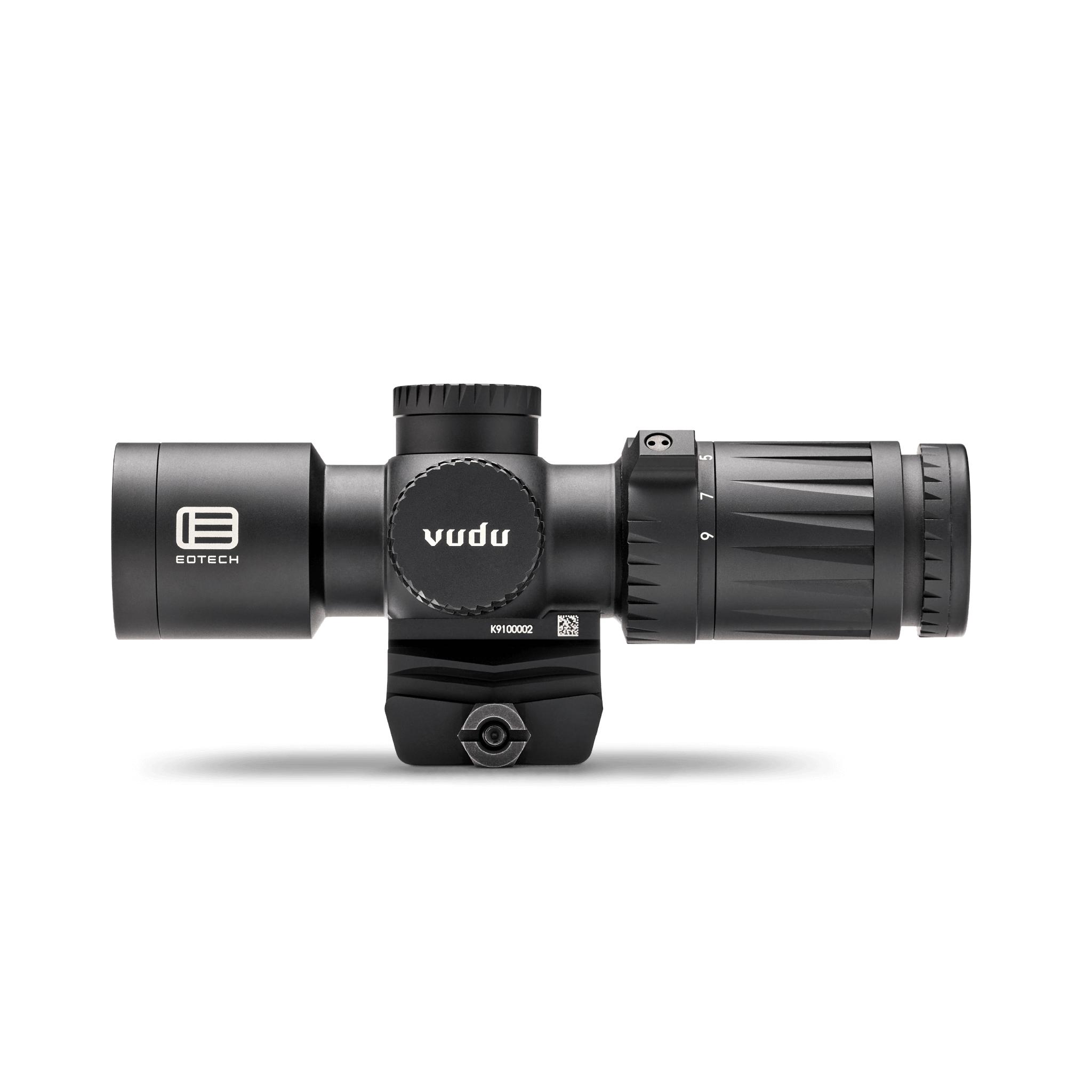
Every few years the optics world rediscovers something old. Red dots gave way to low-power variables (LPVOs, the 1-6x and 1-8x scopes that live on most modern ARs), and now EOTech has gone back to the magnification range on your grandfather’s deer rifle. The Vudu 3-9×32 SFP is a full 3-9x variable scope squeezed into a 6.8-inch, 16-ounce body that bolts to the gun with a mini-ACOG mount. No rings, no separate mount, no LPVO hanging over the handguard.

It shipped in spring 2025, and since then it has become one of the most argued-about optics on YouTube. RECOIL’s Iain Harrison rang steel at 500 meters with it and liked it. Thin Line Defense Co. named it the worst optic of 2025. Hop, whose review has over 200,000 views, landed somewhere in the middle. For 2026 EOTech has answered the loudest complaint with a new MR5 reticle and added a tan finish, so it’s a good time to sort out what this thing actually is.
What It Is, and What’s New for 2026
The Vudu 3-9×32 is a second-focal-plane scope (SFP, meaning the reticle stays the same size as you zoom) with a 30mm tube, a 32mm objective, Japanese XC high-density glass, and a nitrogen-purged forged aluminum body. Instead of a conventional tube you’d clamp rings around, the bottom of the housing is a mini-ACOG interface, and EOTech includes a Picatinny adapter that puts the centerline about 1.5 inches above the rail. Any aftermarket mini-ACOG mount, including quick-detach ones, will fit.

|

|
The original and still-standard reticle is the HC1, an MOA crosshair with hash marks and a center dot that measures 1.2 MOA at 9x. Illumination runs through a side dial with 10 settings and an off position between each. It’s powered by a CR2032, and EOTech quotes around 300 hours of runtime.
New for 2026 is the MR5 reticle, offered in both MOA and MRAD (milliradian) versions, and a tan-anodized finish. The MR5 is a busier grid-style design with holdover and wind references, and it appears to be EOTech’s response to a year of complaints about the HC1. EOTech also launched a bigger sibling, the Vudu 4-12×36 FFP, and an enclosed EFLX CE red dot, which matters because the EFLX is the dot EOTech sells piggybacked on this scope.
Specs at a Glance
Figures are from EOTech’s published spec sheet as reported by GunsAmerica, Optics Force and Hook & Barrel.
| Magnification | 3-9x, second focal plane |
| Objective / tube | 32mm / 30mm |
| Length | 6.8 in (172.7mm) |
| Weight | 16 oz (454g) scope with integrated mount |
| Reticle | HC1 (MOA) illuminated; MR5 in MOA or MRAD new for 2026 |
| Illumination | 10 settings, rotary dial, CR2032, about 300 hours |
| Eye relief | 2.5–3.1 in at 3x, 2.3–3.1 in at 9x |
| Exit pupil | 10.7mm at 3x, 3.6mm at 9x |
| Field of view | 38 ft at 3x, 12.7 ft at 9x (100 yards) |
| Turrets | Capped, 1/4 MOA clicks, 30 MOA per revolution, re-zeroable |
| Total adjustment | 90 MOA elevation, 60 MOA windage |
| Parallax | Fixed (no side focus) |
| Mount | Integrated mini-ACOG footprint, Picatinny adapter included, ~1.5 in height |
| Construction | Forged aluminum, nitrogen purged, water/fog/shock resistant, made in Japan |
| Colors | Black; tan (2026) |
| UPC (black, HC1) | 672294110309 |
| MSRP | $1,059 scope only; $1,429 with EFLX red dot and ring mount |
The Piggyback Red Dot
Even at 3x this is too much magnification for close, fast shooting, and EOTech knows it. The package version adds a ring that clamps around the objective bell and carries a Leupold DeltaPoint Pro footprint, with an EFLX mini red dot in the box. The ring rotates, so you can run the dot at 12 o’clock or at a 45-degree offset. Hop measured a complete package at about 19 ounces with the dot mounted, which is roughly what a bare 1-6x LPVO weighs before you add a mount.
The catch is the EFLX itself. Hop and Thin Line Defense both said it doesn’t get bright enough for full daylight, and Hop noted the DeltaPoint Pro footprint lets you swap in a Vortex Defender or a DeltaPoint Pro instead. TREX Armory, shooting under cloudless Arizona sun, found the EFLX visible on max brightness but not by a wide margin. If you buy the package, budget mentally for a different dot down the road.
What Reviewers Found
RECOIL’s Iain Harrison gave the Vudu the most favorable field test. After a 100-meter zero he used the HC1 hashes to hit at 300, 350 and 500 meters on the first attempt at each, holding a target or two into a 12 to 15 mph crosswind. He called the glass edge-to-edge clear, found the illumination daylight-bright in Arizona sun, liked the smooth zoom and the lift-and-turn re-zeroable turrets, and said it “frees up a ton of rail space.” His only asks were a quick-detach mini-ACOG mount and a 45-degree dot instead of 12 o’clock to keep his cheek weld.
Hop’s take was “not a great optic, but there’s a nugget of a good idea in there.” He praised the build and the short, fast zoom throw, then listed the compromises: noticeable warping at the edges on 3x, chromatic aberration at 9x, an eye box that tightens hard at the top end, and no auto-off on the illumination. His biggest gripe was the HC1 reticle. The hashes sit every 2 MOA and the 30 MOA of drop is split into a 16 MOA block and a 14 MOA block, so you count from 16 instead of from a round number. He thinks the Vudu makes sense on a lightweight battle rifle or a bullpup like the Springfield Hellion, where a normal LPVO would hang over the tiny rail.
Thin Line Defense Co. was the harshest, and it’s worth stating up front that the reviewer disclosed a marketing discount on the unit and a strong prior loyalty to EOTech. The complaints overlap with Hop’s: the 16/14 MOA reticle split, a throw lever too short to be useful on a scope you really only run at 3x or 9x, turrets with almost no indexing and barely audible clicks, no parallax adjustment, and an eye box at 9x tight enough that the reviewer struggled to track impacts under recoil. The channel ranked it F-tier and pointed out that the Primary Arms PLxC 1-8 weighs about the same and costs about the same.
TREX Armory’s Brandon, who disclosed the unit was a free sample and that his store sells EOTech, split the difference. With an 11.5-inch carbine and 62-grain PMC he shot groups just under 2 inches at 100 yards, with his best three-round group under an inch. He hit a 300-yard gong and a 450-yard silhouette in reasonable time. Glass, in his words, was “not Nightforce,” with a fishbowl effect at 9x, and he couldn’t see dirt splash at 400 yards the way he can through his ATACR. On close target transitions the piggyback dot was one to two seconds faster than the magnified tube. He also contradicted RECOIL on one point: the reticle illumination was visible in daylight but “absolutely not daylight bright.”
Two print-style reviews back up the positives. Optics Force called it “potentially disruptive,” used it as a precision rimfire scope and rang steel to 400 yards, but flagged the fixed parallax, which makes targets beyond 100 yards “distractingly fuzzy,” and the poorly indexed turrets. Hook & Barrel ran it on a Wilson Combat 300 Blackout and got consistent sub-inch groups with 220-grain subsonics, with zero holding through rough handling.
Sorting Out the Disagreement
Read all six and a pattern emerges. Nobody disputes that the glass is good for its size, that the build is solid, that zero holds, and that a 6.8-inch scope with an integrated mount is genuinely convenient. Everybody who dislikes it is unhappy about the same three things: the HC1 reticle’s odd layout, turrets you can’t dial with, and the fixed parallax plus tight 9x eye box that come with cramming a 3x erector into a body this short.
The reticle complaint is the one EOTech can fix, and the 2026 MR5 option is exactly that fix. The turrets are capped by design; this is a set-and-forget, hold-over scope, and buyers expecting to dial elevation are buying the wrong optic. The parallax and eye box are physics. A first-focal-plane version or a 1-4x version would be worse, not better, and Hop said as much.
Price & Availability
MSRP is $1,059 for the scope alone and $1,429 with the EFLX and ring mount. Street pricing has settled around $999 for the black HC1 scope, and Hop found the full package for $1,200 at EuroOptic. The MR5 versions and the tan finish are listed as in stock at EuroOptic and other retailers as of this writing. Used examples show up regularly on trader boards at $750 to $900, which tells you something about how many early buyers changed their minds.
Who It’s For
This is a compromise optic, and it works for people who value what it gives up other things to deliver. If you run a bullpup, a pistol-caliber carbine with a short top rail, or a lightweight general-purpose rifle where every ounce and inch counts, the Vudu 3-9×32 does what nothing else in its size does. It also makes a surprisingly good scope for a straight-wall deer carbine, a slug gun, or a precision .22, where 9x is plenty and nobody dials turrets.
If you’re building a standard 16-inch AR and want one optic to do everything from 10 yards to 600, a 1-8x LPVO in the same price bracket will shoot better and give you a true 1x. The Vudu only wins that fight when rail space or weight is the deciding factor.
Pros & Cons
Pros
- 6.8 inches and 16 ounces with the mount built in; nothing else offers 3-9x this small
- Japanese glass and forged body; every reviewer reported it held zero
- Mini-ACOG footprint means quick-detach and low mounts already exist
- Optional rotating ring puts a red dot at 12 o’clock or 45 degrees
- Re-zeroable capped turrets and a short, fast zoom throw
- Cheaper than an ACOG, and the MR5 reticle fixes the biggest complaint
Cons
- HC1 reticle’s 16/14 MOA split is awkward to count
- Fixed parallax; targets past 100 yards can look soft at 9x
- Tight eye box and some edge distortion at both ends of the zoom
- Turrets have minimal indexing and faint clicks; not made for dialing
- Included EFLX dot is dim for bright daylight
- Around $1,000 puts it against very good 1-8x LPVOs
Verdict
The Vudu 3-9×32 is a good idea executed with real compromises, and whether it’s a good buy depends entirely on your rifle. On a bullpup or a short-railed carbine it solves a problem no LPVO can. On a plain AR it’s a $1,000 scope that loses to cheaper, bigger competition on the things that matter most at the range. Buy the MR5 version if you buy one at all, plan on a brighter dot than the EFLX, and don’t expect the turrets to do more than hold zero.
Is a 3-9x in an ACOG-sized body the right tool for your rifle, or would you rather have a 1-8x LPVO and live with the length? Tell us in the comments.

