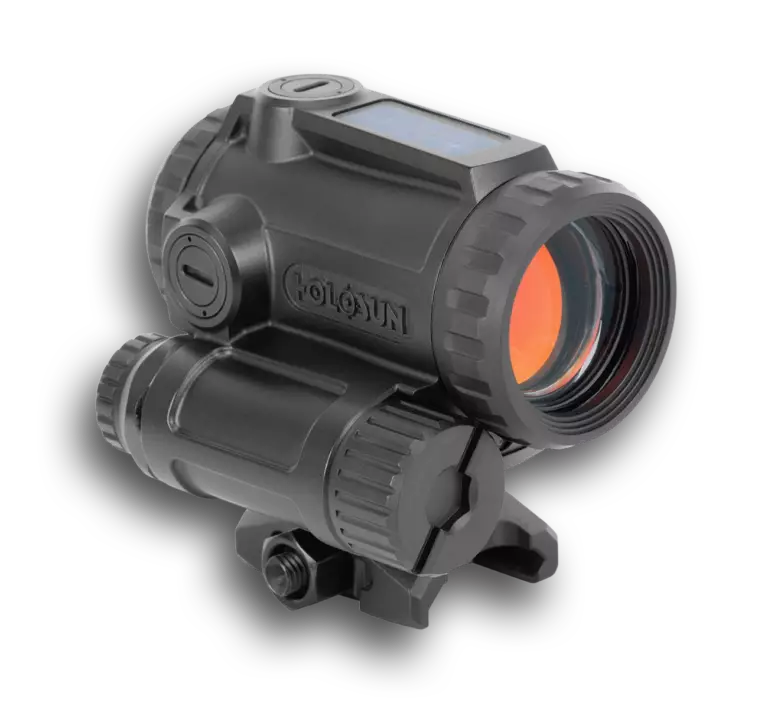
Holosun has spent the last few years shrinking optics and stuffing more features into them. For 2026 the company went the other direction with its rifle dots: instead of a smaller sight, it built two that swallow a whole laser aiming module. The ARO Evo Dual and AEMS Evo Dual put a red dot, a visible green laser and an infrared (IR) laser into a single housing, all zeroed together off the same turrets.

Both optics debuted at SHOT Show 2026 in January and are listed on Holosun’s site as “New for 2026, coming Q3.” The pitch is simple: if you shoot a short-railed gun and want night-vision capability without stacking a $1,500 laser box on the handguard, this is the first realistic option that doesn’t come from Wilcox at several thousand dollars. Here’s what’s actually in the box, what the specs say, and what the people who handled them at SHOT think.
What’s New
The ARO Evo Dual starts with last year’s ARO Evo, Holosun’s Aimpoint T2-style tube dot with a 26mm window. The AEMS Evo Dual starts with the new AEMS Evo, an enclosed box sight whose 1.26 × 0.98-inch window is about 29 percent larger than the original AEMS. Neither base optic changed much optically. What changed is a laser emitter package built into the lower front of the housing that fires out through the objective lens.

|

|
That placement is the whole trick. Because the lasers ride inside the optic, they move with the dot’s windage and elevation adjustments. Holosun calls this “Tri-Channel Zeroing”: zero the dot and the green and IR lasers are zeroed too. You are not walking downrange at 11 p.m. with a screwdriver to sort out a separate laser box. The other consequence is that the dot switches from a coin cell to a CR123A battery, because a green laser and an IR emitter need more juice than a CR2032 can supply.
Controls are the same on both models. A rotating dial on the battery cap picks the mode: rotate one way for IR, center for off, the other way for visible, as GunsAmerica described from the booth. A fire button on the housing activates the selected laser, and a Crane-standard plug at the rear takes the included dual-button pressure pad. Only one plug is present, so you cannot run two remote switches.
One feature that impressed several reviewers is a visible-override mode. Press the visible-laser button on the pad and the optic fires the green laser and jumps the dot from its night-vision brightness to a daylight setting at the same time. If you’re aiming passively under night vision and a light comes on, one press gets you back to a usable sight picture and a visible laser without touching the brightness buttons.
Specs at a Glance
All figures below are from Holosun’s product pages unless noted. Both optics share the same laser and electronics package, so the meaningful differences are window, housing, weight and price.
| Spec | ARO Evo Dual | AEMS Evo Dual |
|---|---|---|
| Window | 26mm (1.02″) round | 1.26″ × 0.98″ |
| Reticle | Red MRS: 2 MOA dot, 65 MOA circle, or circle-dot | |
| Visible laser | Green, 520nm, under 5mW, Class 3R | |
| IR laser | 850nm, under 0.7mW, Class 1 | |
| Battery | One CR123A, side tray | |
| Battery life (Holosun figures, setting 6) | Dot up to 300,000 hrs; green laser 12 hrs; IR laser 50 hrs | |
| Brightness settings | 8 daylight, 4 night vision | |
| Adjustment | 0.5 MOA per click, ±50 MOA travel | |
| Housing | Hard-anodized 6061-T6 aluminum* | Hard-anodized 7075-T6 aluminum |
| Body size | 2.68″ × 1.77″ × 2.6″ | 3.03″ × 2″ × 2.68″ |
| Body weight | 8.15 oz (mount 2.45 oz) | 10.6 oz |
| Mount height | 1.63″ (lower 1/3 co-witness) | 1.63″ (lower 1/3 co-witness) |
| Water / shock | IPX8 submersible, 1000G vibration rated | |
| Solar failsafe / Shake Awake | Yes / Yes | |
| Lockout mode | No | Yes |
| UPC | 810047074434 | 810047074441 |
| MSRP | $588.22 | $823.52 |
*Holosun’s ARO Evo Dual page describes a 6061-T6 housing in the feature copy but lists 7075-T6 in its spec table. Brownells’ listing says 6061. We’ve gone with 6061 until Holosun clarifies. Brownells also lists slightly different body dimensions and a 7.76 oz weight for the ARO; we used Holosun’s numbers.
ARO Evo Dual: The Compact One
The ARO Evo Dual is the one most people will actually buy. It rides on the T2-pattern mount you likely already own spares of, it weighs a little over 8 ounces before the mount, and the laser bulge underneath looks a lot like the battery housing on an old Aimpoint CompM3. The solar panel on top stays, along with the forward-facing light sensor that meters the target area rather than the light over your shoulder.
Holosun told GunsAmerica the ARO version would ship with a taller 1.93-inch mount in addition to the standard lower-third pedestal. That matters, and we’ll get to why in the reviewer section. The product page’s in-the-box list currently shows only the optic, the pressure pad, a lens cloth, a multi-tool, a wrench and the manual, so treat the second mount as unconfirmed until units land.
One detail from the Holosun rep in the Stonewall Collective video: the solar failsafe covers the optic only. If the CR123A dies, the panel will keep the dot running, but it won’t drive the lasers. A green laser at full output is a hungry thing.
AEMS Evo Dual: The Big Window
The AEMS Evo Dual is the same electronics wrapped in the enclosed AEMS Evo body, so you get the bigger rectangular window, flip caps and a 7075-T6 housing. Where the standard AEMS Evo has a removable mount, the Dual fills that area in to make room for the laser module and the Crane port, so it is a fixed-height, direct-to-Picatinny optic. It is roughly 2.5 ounces heavier than the ARO and about $235 more at MSRP.
Holosun’s booth staff pointed out one physical difference to Stonewall Collective: the AEMS version puts a protective cover over the laser aperture. Get mud in it, flip the cover and it folds flat. The AEMS also gets a button lockout mode, which the ARO page lists as “No.” If your rifle lives in a rack where brightness buttons get bumped, that’s a point for the box.
What Reviewers Found at SHOT
Production units aren’t in reviewers’ hands yet, so everything below comes from hands-on time at Holosun’s SHOT Show range day and booth. Gun Talk Media’s Kevin Jarnagin got the walkthrough straight from Holosun’s Adam Litke, who framed the target user plainly: MP5s, bullpups and other guns with almost no rail space. Litke also flagged a second use most people miss. The visible laser lets an instructor show a student exactly how far height-over-bore throws their shots up close, and where the muzzle wanders as they press the trigger.
BrassTactics from TheNovaGroup brought his own night vision to the range day and came away with the most detailed take. He confirmed the lasers are co-aligned with the dot but parallel-offset, meaning at close range the beam sits slightly below and beside the dot rather than exactly on top of it, which is normal for any laser that isn’t emitting from the same axis as the reticle. He liked the override button a lot and noted that on one unit it also switched reticles when pressed, suggesting the override behavior is programmable. His main gripe was practical: with your thumb on a two-button laser pad, how do you also run a white light?
TFBTV’s James Reeves and Luke were the skeptics. Their first complaint is one every buyer should weigh: there is no IR illuminator in either optic. In their view, if it’s bright enough to get by on an IR pointer alone, you can usually just passive-aim through the red dot without adding any downrange signature. Their second complaint is the one that produced the 1.93-inch mount promise. On a lower-third mount the laser emitter sits low enough that a support-hand thumb wrapped over the handguard can block the beam. Holosun told them a taller mount should be included when the optic ships.
Stonewall Collective’s booth interview added the pricing context. In January a Holosun rep quoted “right around the $500 area” for the ARO Dual and roughly $200 more for the AEMS Dual. The rep also said battery life numbers were still being finalized, which is worth remembering when you read the 300,000-hour dot figure now on the product page. That number is at setting 6 with the lasers off, and Holosun does not say how quickly the IR and visible laser runtimes (50 and 12 hours) stack on top of it.
Price & Availability
Holosun lists the ARO Evo Dual at $588.22 and the AEMS Evo Dual at $823.52. Street pricing at Brownells and MidwayUSA is $499.99 and $699.99 respectively, which lines up with the targets Holosun quoted at SHOT. Both are listed as backorder or notify-me items at the major retailers as of this writing, and Holosun’s own pages still say “coming Q3.” Given Holosun’s SHOT Show track record of showing pre-production gear that slips, we wouldn’t plan a build around a specific week.
Both come in red reticle only for now. Given that the standard ARO Evo and AEMS Evo ship in red, green and gold, more colors seem likely later, but Holosun hasn’t announced them.
Who It’s For
This is not a replacement for a full laser aiming module on a 16-inch AR. A dedicated unit like Holosun’s own IRIS series sits at the end of the rail, adds an illuminator, and keeps beam splash off your handguard. If you have the rail space and the budget, that setup is still the better tool for serious night-vision work, and TFBTV is right to say so.
The Evo Dual line makes sense in three places. First, guns with no real estate: MP5 and AP5 clones, the Flux Raider, a B&T or SIG MPX with a short handguard, an MP7-style PDW, or a bullpup. Second, guns whose handguards don’t hold laser zero, where the only rigid mounting surface is the receiver. Third, instructors and casual night-vision users who want an IR pointer for occasional use without buying and zeroing a separate box. If you’re shopping the ARO Evo already and want to leave the door open to night vision, the roughly $250 premium over a standard ARO Evo is hard to argue with.
Pros & Cons
Pros
- Red dot, green laser and IR laser in one housing, all zeroed together
- Crane-standard plug and an included two-button pressure pad
- Visible-override mode jumps the dot to daylight brightness and fires the laser with one press
- T2-pattern mount (ARO) and CR123A power instead of a coin cell
- Roughly $500 to $700 street, against several thousand for the Wilcox equivalent
- Solar failsafe, Shake Awake, IPX8 and 1000G rating carried over from the base optics
Cons
- No IR illuminator, which limits real night-vision usefulness on dark nights
- Laser emitter sits low; a support-hand thumb can block it on a lower-third mount
- Single Crane port, so no separate white-light switch on the same pad
- Laser runtimes are short next to the dot (12 hours green, 50 hours IR)
- Still not shipping as of September 2026, and some details (mount, housing alloy) remain unclear
Verdict
Holosun didn’t invent the laser-in-a-red-dot, and TFBTV is right that the category has a spotty history. What Holosun did is bring it down from Wilcox money to ARO money while keeping everything people like about the ARO Evo and AEMS Evo. For the shooter with a subgun or PDW and a pair of night-vision goggles in the closet, the ARO Evo Dual is the most practical way to add an IR pointer we’ve seen at this price. For everyone else, the standard ARO Evo at half the cost still does the job, and the lack of an illuminator means the Dual isn’t a shortcut to a real night-fighting setup.
We’ll revisit both once production units ship and someone puts a few thousand rounds through the laser package. Until then, the specs are promising, the price is right, and the caveats are real.
Would you run an integrated dot-and-laser on a PDW or subgun, or does the missing illuminator make it a non-starter for you? Let us know in the comments.