Ruger Harrier Review: A $749 AR-15 That Gets the Basics Right
The Ruger Harrier replaces the AR-556 with a mid-length, free-floated AR-15 near $600. Here's what five range tests found.
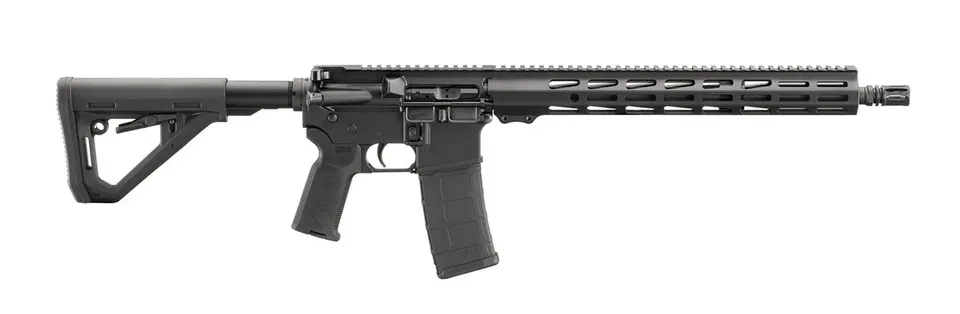
Ruger's AR-556 was a perfectly decent rifle that spent its last few years getting undercut. Palmetto State Armory, Radical Firearms and half a dozen others were selling free-floated, M-LOK-railed carbines for less money, and the AR-556 started to look like a 2015 rifle with a 2025 price tag. The Ruger Harrier is the answer to that problem: a ground-up replacement that costs less than the gun it retires and comes with the parts people were bolting on anyway.
It's also the first new Ruger to come out of Hebron, Kentucky, the former Anderson Manufacturing plant Ruger bought in July 2025. So the Harrier is two stories at once. It's a budget AR-15 with a street price hovering around $600, and it's the first real look at what Ruger intends to do with all that AR-building capacity. We went through the manufacturer's specs and five published range tests to see how the first chapter reads.
Latest prices for Ruger Harrier Model 28600
| Store | Price | Deal |
|---|---|---|
| MidwayUSA | $579.99 | View Deal |
| GrabAGun | $579.99 | View Deal |
Prices as of November 18, 2026 and may have changed.
What's New Compared to the AR-556
Short version: the Harrier is the AR-556 with the wish list filled in. Ruger sells two versions, and the differences between them matter.
- Model 28600 ($749 MSRP) is the one most reviewers have. It has a mid-length gas system, a slim 15-inch free-float handguard with a full-length Picatinny top rail, a Magpul DT Carbine stock and a Magpul MOE-K2 grip.
- Model 28601 ($699 MSRP) is the plain one: A2-style grip, M4-style collapsible stock and an interrupted top rail. Distributor Lipsey's, which helped Ruger with pre-release testing, and Firearms News both list it with a carbine-length gas system.
Both share a 16.1-inch nitrided barrel with a 1:8 twist, a threaded muzzle, forged 7075 receivers and a nitrided bolt carrier group with a staked gas key. Both ship with one 30-round Magpul PMAG and no sights, so budget for an optic.
The $50 gap makes the choice easy. A mid-length gas system (the gas port sits farther down the barrel, which softens the recoil impulse and is a little gentler on parts) plus Magpul furniture and a full top rail would cost you far more than $50 to add later. Unless you specifically want the lighter, simpler gun, the 28600 is the one to buy.
Ruger Harrier Specs at a Glance
These are Ruger's published numbers for the Model 28600.
| Caliber | 5.56 NATO |
| Action | Direct-impingement semi-auto, mid-length gas system |
| Capacity | 30 rounds (one Magpul PMAG included) |
| Barrel | 16.1 in., Government profile, 6-groove, 1:8 RH twist, nitrided |
| Muzzle | 1/2x28 threads, A2 flash hider |
| Handguard | 15 in. free-float, full Picatinny top rail, M-LOK at 3, 6 and 9 o'clock |
| Receivers | Forged 7075 aluminum, Type III hardcoat anodized |
| Stock / Grip | Magpul DT Carbine / Magpul MOE-K2 |
| Trigger | Single-stage mil-spec |
| Sights | None |
| Overall length | 35.87 in. |
| Length of pull | 10.75 to 14 in. |
| Weight | 6.8 lb. |
| MSRP | $749 (Model 28601: $699, 6.6 lb.) |
The Small Details Ruger Got Right
Spec sheets for budget ARs all look alike. What separates them is the stuff that doesn't make the headline, and this is where the Harrier earns some credit.
There's a tension screw hidden in the lower receiver, just above the grip, that takes the wobble out of the fit between upper and lower. Colion Noir said that lockup was the first thing he checked, because a rattling receiver set is where cheap rifles usually give themselves away, and he found the Harrier tight enough to rival rifles at nearly twice the price. Elliott Delp's team made the same point: no shims needed, no slop.
The castle nut and gas key are both staked, which is the kind of assembly step that gets skipped when a factory is chasing a price. The handguard has anti-rotation tabs and QD sling sockets on both sides, and the stock has a QD socket too. The extra M-LOK slots angled around the muzzle end give you more options for mounting a light. You also get a forward assist, dust cover and brass deflector, which some budget uppers now leave off.
One nice touch Lipsey's pointed out: the selector is a standard 90-degree unit, but the "fire" marking sits at 45 degrees, so a short-throw aftermarket safety will line up correctly if you add one.
The Trigger Is the Weak Spot
Every reviewer landed on the same complaint. The Harrier uses a plain single-stage GI trigger, and it feels like one.
Firearms News executive editor David Fortier measured his sample at about 6 pounds and called it a bit gritty, though consistent with a clean reset. Hook & Barrel's Brian McCombie described his as stagey. Elliott Delp's rifle was the worst of the bunch at right around 8 pounds on their gauge, heavy enough that they noticed it when shooting groups and felt it slow their follow-up shots.
That spread, 6 to 8 pounds across samples, tells you what to expect: a trigger that works, will probably smooth out a little with use, and is the first thing worth replacing. The good news is that the Harrier takes any standard AR-15 trigger, and a decent drop-in unit costs less than the money you saved by not buying a pricier rifle.
At the Range: What Reviewers Found
Reliability first, because it's the easy part. Nobody has reported a stoppage.
- Lipsey's put more than 1,000 rounds through the two models combined during Ruger's pre-release testing, including brass and steel case, full metal jacket and soft points, fed from PMAGs, GI magazines and beat-up parts-bin mags. Everything ran.
- Hook & Barrel fired 200 rounds straight out of the box without cleaning the rifle first, suppressed and unsuppressed, with no failures to feed or eject.
- Elliott Delp, who bought their rifle with their own money, reported a few hundred trouble-free rounds, much of it with a compact CMMG suppressor.
- Firearms News saw consistent ejection to 3 o'clock with all three loads tested and no malfunctions.
Accuracy is more interesting, because it depends heavily on what you feed it. With ammunition the rifle likes, it shoots better than a $600 AR has any right to. Fortier's groups at 100 yards came in at 1.3 inches with both Black Hills 55-grain TSX and Federal Fusion 62-grain, and he followed that with 30 consecutive hits on a full-size steel silhouette at 280 yards using a 1-4x optic. McCombie's best five-shot groups ran from 1.25 to 1.7 inches. Lipsey's got just under an inch with Black Hills match ammo.
Elliott Delp's "average Joe" testing, done with locally bought ammo, shows the other side. Hornady Varmint Express 55-grain printed 1.2 MOA and Hornady Black 62-grain FMJ managed 1.5. PPU M193 training ammo opened up to 2.8, M855 green tip to 4.9, and Hornady Black 75-grain hollow points scattered to 7.8, a result they found surprising from a 1:8 barrel. Their conclusion was that it's generally a sub-2 MOA rifle if you take the time to find its load.
Here's Elliott Delp's full review, including the group-by-group breakdown:
A caveat on those numbers: they come from different shooters, optics and group counts, so don't treat them as a controlled comparison. The pattern is still clear. Quality 55- to 69-grain loads shoot well, bulk ammo is acceptable for training, and one bad result with heavy bullets is a reminder to test before you buy a case.
How It Handles
At 6.8 pounds bare with a slim rail, the Harrier is on the light side for a 16-inch AR, and reviewers liked how it carries. Colion Noir called out the balance specifically, neither nose-heavy nor tail-heavy, which makes moving between targets feel natural. He shot it back to back with an HK MR556 and said that while the HK was softer, stepping back to the Ruger didn't feel like a downgrade.
Recoil is ordinary 5.56 recoil. The mid-length gas system and carbine buffer keep it mild, and McCombie noted that adding a suppressor took even more out of the recoil pulse. Delp's crew did get the usual face full of gas when running their short suppressor, which is normal for a direct-impingement gun without an adjustable gas block.
Colion Noir's take is worth watching for the bigger argument he makes about who actually needs more rifle than this:
Price and Availability
Ruger's suggested retail is $749 for the Model 28600 and $699 for the 28601. Real-world pricing is lower. Multiple reviewers who bought or priced the Magpul-equipped rifle put it at roughly $600 to $650, which is where it needs to be to compete with the PSA Guardsman, Radical Firearms' 5.56 carbines and the IWI Zion-15 it gets compared against.
Both models have been shipping since the start of 2026, though Ruger's own site currently lists the 28600 as limited availability. Lipsey's has hinted that more variants are coming. The live price table near the top of this page tracks current dealer pricing for the Model 28600.
Who It's For
The Harrier is built for the buyer who wants one rifle and doesn't want a project. If this is your first AR-15, or you want a home-defense and range carbine you can zero and trust without first watching forty videos about gas port sizes, it fits. It's also a sensible base for upgrades, since everything on it is standard AR-15 pattern and the parts you'd normally swap first (stock, grip, handguard) are already good.
It's less compelling if you already own a couple of ARs or enjoy building them. You can assemble something with a better trigger and a fancier muzzle device for similar money, and some competitors offer comparable features for a little less. What you're paying for here is Ruger's name, its customer service and a rifle that arrives properly put together.
Pros and Cons
Pros
- Mid-length gas, free-float M-LOK rail and Magpul furniture at a street price near $600
- No malfunctions reported in any of the five tests we reviewed
- Staked gas key and castle nut, receiver tension screw, QD sockets front and rear
- Capable of 1 to 1.5 MOA with ammunition it likes
- Threaded 1/2x28 muzzle and a 1:8 twist that suits common bullet weights
Cons
- Heavy, gritty mil-spec trigger that varied from about 6 to 8 pounds between samples
- Ships with no sights at either price
- Accuracy with bulk and some heavy loads is mediocre
- Basic A2 flash hider and GI charging handle
- New factory, new rifle: long-term durability is still unproven
Verdict
The Ruger Harrier doesn't do anything new, and that's the point. It takes the parts list the market settled on years ago, assembles it carefully and sells it for less than the rifle it replaces. Every tester who has run one came away with the same summary: it works, it shoots straight with decent ammo, and the trigger is the only part that feels like its price.
The open question is time. This is a first-year rifle from a factory that only recently started building guns under the Ruger name, and a few hundred rounds per reviewer isn't a durability test. But as a first impression of what Ruger plans to do in Kentucky, it's a strong one. If you want a no-drama AR-15 and you'd rather spend the difference on an optic and ammunition, start here.
Sources: Ruger's Harrier Model 28600 spec sheet, David Fortier's Harrier range test at Firearms News, Hook & Barrel's 200-round Harrier review, and video reviews from Lipsey's, Elliott Delp and Colion Noir.
Would you take the Harrier over a PSA or an IWI Zion at the same price, or does the trigger send you elsewhere? Tell us what your first AR-15 was and whether you'd buy it again.
Learn more about our editorial process and how we test.